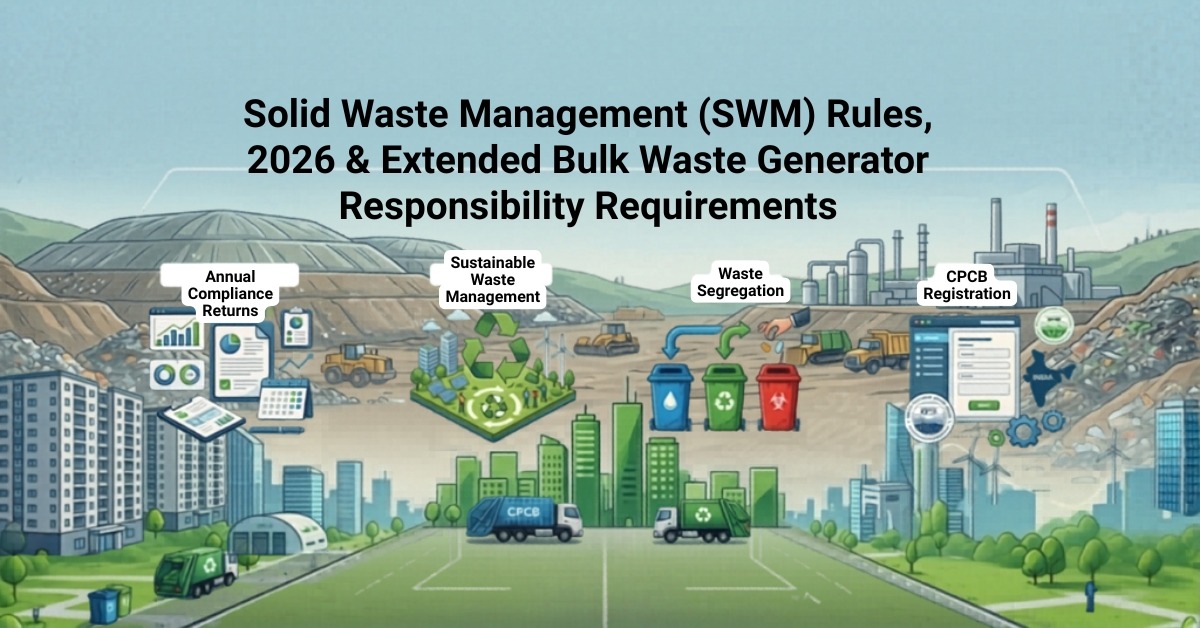
The Union Ministry of Environment, Forest and Climate Change has notified the Solid Waste Management (SWM) Rules, 2026, superseding the Solid Waste Management Rules, 2016. The rules have been notified under the Environment (Protection) Act, 1986 and will come into full effect from April 1, 2026.
The scope of this rule is very wide that covers every waste generator and impose duties relating to waste segregation, storage, collection, disposal, and other responsibilities prescribed under the rules. The waste generator has been defined under Rule (3)(1)(zzh) , which includes every person or group of person ,every residential premises and non-residential establishment including Indian Railways , defence establishment which generator solid waste.
Every waste generator is required to segregate and store the waste generated by them in for separate steams at source namely wet waste, dry waste, sanitary waste andspecial care waste and handover the segregated waste to authorised waste pickers or waste collectors as per the direction and notification of local authority
This rule has also introduced a new concept of Extended Bulk Waste Generator Responsibility (EBWGR) along with specific responsibilities and compliance obligations for Bulk Waste Generators. We will now try to understand this new concept and the responsibilities associated with it under the rules.
1. Who is Bulk Waste Generator?
A person is said to be a bulk waste generator if it satisfied at least one of the following criterion
- Building with floor area of 20000 square Meter or above or
- Water consumption of 40000 litres per day or
- Solid waste generation of 100 kg per Day, namely
a. Institutional users including buildings occupied by the
- Central government departments or undertaking, state government departments or undertakings
- Local bodies
- Public sector undertaking or private Companies
- School , college ,universities other educations institution, and
- Community places or like
b.Commercial users including :
- Commercial establishment including railways ,bus stations or depots ,airport’s , Ports
- Industrial unit and industrial areas
- Malls ,multiplexes
- Hotels
- Hospital ,nursing homes
- Wholesale markets , Including Mandis for agricultural and horticultural produce ,fish and meat
- Stadium, sports complexes
- Community halls, convention halls ,auditorium
- Marriage or banquet halls
- Conference centres, expo centre, exhibition areas and
- Tourist spots
c. Residential Societies
2. What is extended bulk waste generator responsibility (EBWGR) mean?
It means a bulk waste generator who is required to get registered with concerned local body through centralised portal of Central pollution control Board (CPCB) and responsible for proper management and disposal of solid waste generated by them. Bulk Waste Generators are required to process wet waste on-site as far as possible or obtain an EBWGR certificate where on-site processing is not feasible
This framework aims to strengthen waste management practices, as bulk waste generators account for nearly 30 per cent of total solid waste generation.
3. What are the compliances required to be complied with by a Bulk Waste Generator under these rules?
A Bulk Waste Generator, apart from ensuring collection and segregation of solid waste, and procuring Extended Bulk Waste Generator Responsibility (EBWGR) Certificates from the local body, is also required to submit annual returns on or before 30th June of every year through the centralized online portal.
Such annual returns shall include details relating to the Extended Bulk Waste Generator Responsibility obligations, including procurement of EBWGR Certificates corresponding to the total calculated solid waste generated by them. The annual returns submitted by the Bulk Waste Generator shall further be submitted to the concerned local body for processing, and the same shall be made available in the public domain on the website of the local body on a yearly basis.
This rules integrate the principles of Circular Economy and Extended Producer Responsibility, with a specific focus on efficient waste segregation and management. The rules provide for the levy of environmental compensation based on the ‘Polluter Pays’ principle for non-compliance, including cases of operating without registration, false reporting, submission of forged documents or improper solid waste management practices.
Request A Call Back
Have questions about compliance? Our team will get in touch to provide the right guidance—just share your contact details.