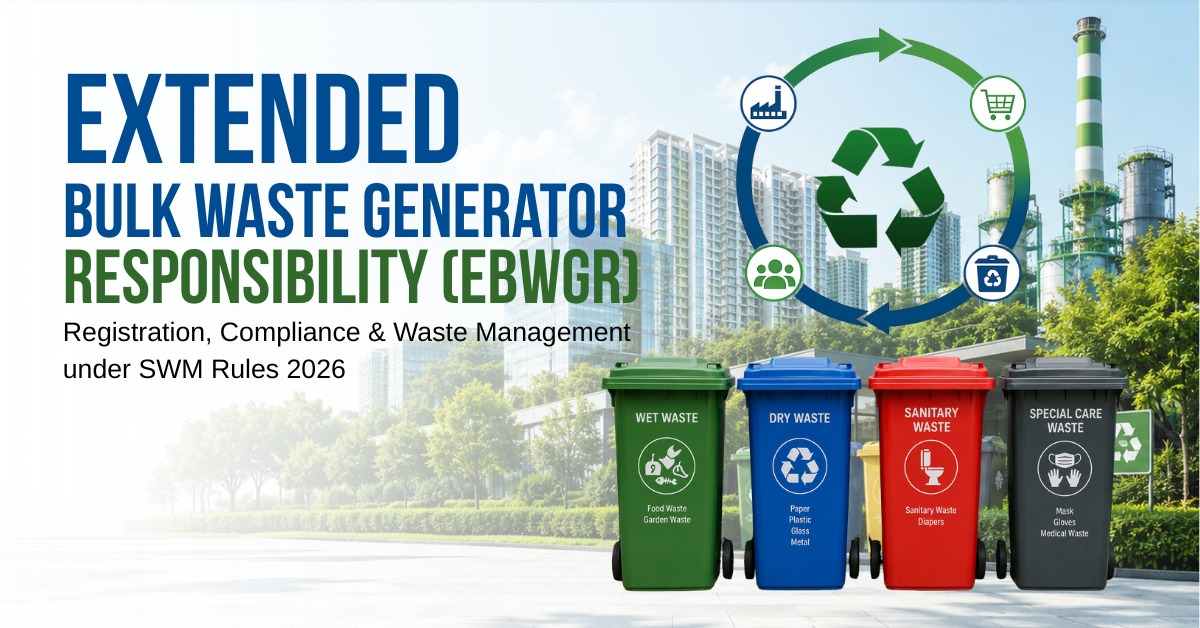
1. What is extended bulk waste generator responsibility?
The Ministry of Environment, Forest and Climate Change has introduced the Solid Waste Management Rules, 2026, which incorporate the concept of Extended Bulk Waste Generator Responsibility (EBWGR). Under these Rules, bulk waste generators are required to take responsibility for the processing of wet waste generated by them and to ensure the environmentally sound management of collected dry waste, special care waste, and sanitary waste.
A bulk waste generator is required to establish and operate a wet waste processing facility of adequate capacity, including for horticulture waste, to ensure processing of the entire quantity of wet waste generated. Where an existing bulk waste generator is unable to establish such a facility, it shall obtain an exemption from the concerned local body and procure Extended Bulk Waste Generator Responsibility (EBWGR) Certificates equivalent to the total wet waste generated
2. What is the objective of extended bulk waste Generator (BWG) responsibility?
The objective of Extended Bulk Waste Generator (BWG) Responsibility is to ensure that bulk waste generators take responsibility for the environmentally sound processing and management of the entire quantity of wet waste generated by them. The framework encourages the establishment of decentralized waste processing facilities such as composting or biomethanation units. Where such facilities cannot be set up, bulk waste generators are required to obtain exemption from the local body and procure Extended Bulk Waste Generator Responsibility (EBWGR) Certificates equivalent to the quantity of wet waste generated, thereby ensuring proper waste processing and reducing the burden on municipal waste management systems.
3.Who is the bulk waste generator?
A person is said to be a Bulk Waste Generator generator if it satisfied at least one of the following criterion
- Water consumption of 40,000 litres per day, or
- Solid waste generation of 100 kg per day namely
a. Institutional users including buildings occupied by the
- Central government departments or undertaking, state government departments or undertakings
- Local bodies
- Public sector undertaking or private Companies
- School , college ,universities other educations institution, and
- Community places or likes
b. Commercial users including
- Commercial establishment including railways ,bus stations or depots ,airport’s , Ports Airports, and Ports
- Industrial unit and industrial areas
- Malls ,multiplexes
- Hotels
- Hospitals and Nursing Homes
- Wholesale markets , Including Mandis for agricultural and horticultural produce ,fish and meat
- Stadiums and Sports Complexes
- Community Halls, Convention Halls, and Auditorium
- Marriage or Banquet Halls
- Conference Centres, Expo Centre, Exhibition Areas and
- Tourist Spots
C. Residential Societies
4. What are the obligation of bulk waste generator?
The obligation of Bulk waste generator can be divided into two parts
a. Pre-Registration Obligations: - The first compliance requirement for every Bulk Waste Generator is to obtain registration through the Centralised Online Portal with the concerned Local Body. Any person or entity meeting the criteria prescribed for a Bulk Waste Generator under the Solid Waste Management Rules, 2026 is required to complete such registration and comply with the conditions specified therein.
b. Post- Registration obligation :- By completing this registration, the entity acknowledges and agrees to fulfil all duties assigned to Bulk Waste Generators under SWM Rules 2026, including but not limited to:
- Ensuring segregation of waste at source into wet waste, dry waste, sanitary waste, and special care waste as per guidelines issued by CPCB and MoHUA;
- Making necessary arrangements for collection and handover of dry waste, sanitary waste, and special care waste to the local body or its authorised agency;
- Setting up and operating wet waste processing facility of adequate capacity in case of new bulk waste generators;
- Filing annual returns by 30th June every year
- Fulfilling Extended Bulk Waste Generator Responsibility (EBWGR) obligations as specified under Rule 39 of SWM Rules 2026 and certificates to be procured from the concerned Local Body etc.
5. What Information is required for Registration as a Bulk Waste Generator? Framework?
The following is an indicative list of information that may be required at the time of registration as a Bulk Waste Generator:
a. Category and Sub-category of the Applicant
b. Floor Area of the Premises
c. Daily Water Consumption
d. Daily Waste Generation
e. Address of the Premises
f. Details of State, District and Local Body
g. PIN Code
h. Latitude and Longitude of the Premises and other details etc.
6. What is the Registration Fee for Bulk Waste Generator Registration?
A registration fee is payable by the Bulk Waste Generator as per the guidelines to be issued by CPCB. However, the payment gateway on the portal is not yet active, and the fee will become payable once CPCB notifies the applicable fee and activates the payment facility.
How can we help you?
BR & Associates provides end-to-end assistance for Bulk Waste Generator Registration and compliance under the Solid Waste Management Rules, 2026. Our services include eligibility assessment, registration support, documentation assistance, compliance advisory, annual return filing, and guidance on Extended Bulk Waste Generator Responsibility (EBWGR) obligations to ensure seamless regulatory compliance.

Need more help?
Feeling inquisitive? Have a read through some of our FAQs or contact our Supporters for help
Frequently asked questions